Where we go from here

Wednesday was a rough day for most Americans. I think no matter your political stripes, we all felt a little bit of shame that day. The idea that people would rush into the Capitol during a ceremony signifying the peaceful transfer of power just seemed like a brand new low, after a year where it felt like we’d already had so many before.

It’s just hard to put into words how depressing this is. In my last blog on here, I wrote about how disheartening it was to see the immediate politicization of the death of Justice Ruth Bader Ginsburg. But that pales in comparison to the images I’ve seen replayed over the last 3 days of people storming into the Capitol building, desecrating not just physical objects like a desk or a podium, but desecrating this idea that at the end of the day, the American experiment would always come out on the other side unscathed.

And let’s get one thing clear. President Trump exhorted the crowd to do this. Seth Abramson has a great thread on twitter where he goes through the entire speech the President gave right before the march to the Capitol. It explains in great detail how explicitly he was calling for more than just a peaceful march down the Capitol Mall.

And the idea that a President can call upon people to do that sort of thing is something that can’t just be brushed aside. That’s why you’ve got so many Democrats and even some Republicans calling for him to be impeached. You need to make it absolutely clear that this is unacceptable.

But there are also some Republicans now saying that we need to move forward. They say that an impeachment would just risk dividing the country further.

I feel like both arguments have some merit. Of course this is the sort of situation that can’t go unpunished. Of course President Trump shouldn’t be able to hold power again. He led an insurrection against this country. Of course people need to see that this sort of thing doesn’t come without a cost.

But I wonder what the actual results of an impeachment would be. First off, at this point, is there anyone in the country whose mind would be changed by Trump getting impeached? Is the goal of an impeachment to change hearts and minds or is it to exact vengeance upon somebody who so righteously deserves it? President Donald Trump is a terrible person. His name will go down on the scrapheap of history, and decades from now, when kids learn about him in history class, pictures of Wednesday’s riot will be listed right next to his name. I don’t know how an impeachment would do anything more to tarnish his reputation than it already has been.

If we do go through with an impeachment, I don’t think things will get better. I think they’ll get worse, because the people who have been emboldened by his bullshit will just continue to feel like they’re being marginalized. I don’t think they have a right to be. I think the victim complex should be put to a stop when you’re the ones who can waltz right in to the Capitol unharmed, months after another group of people were teargassed so the President could walk across the street and hold up a bible. You shouldn’t get to act marginalized with that kind of privilege.

But I do think this would kneecap any sort of coming together that President-Elect Biden is looking for to start his term. He wants to be a unifier. He wants to turn down the temperature. The 74 Million people (sidenote: Trump keeps saying he got 75 million votes. No. Stop that. You got 74.2 Million. That’s not how rounding works.) that voted for President Trump will feel like they’re getting doubly punished.

When considering prison reform, there’s often an idea that prisons should be correctional, not punitive. We want to reform the person that’s committed a crime, not punish them to satisfy our sense of fairness. The right thing would be for Trump to be impeached again. He deserves all the ignominy that comes with being the only President to be impeached twice. But I don’t know if it would be the most productive thing.

President Trump sure as hell deserves to be impeached. But I don’t know if doing so would do much to help the country right now.
On the passing of Ruth Bader Ginsburg

Like everyone around the country, I was saddened to learn of the death of Supreme Court Justice Ruth Bader Ginsburg. But since I learned of the news I’ve actually been trying to avoid reading more about it (Yes, I realize that this sounds pretty hypocritical of me considering I’m writing a blog post about it). I’m avoiding it because her death pretty much typifies everything that’s wrong with politics today, and it’s honestly something that just depresses me to see.

Of course, I’d be remiss if I didn’t acknowledge the legitimately personal reasons that her death has impacted so many people around the country. She’s the longest-serving female justice in the history of the court. Her fiery spirit, exemplified in the fact that she kept up with an intense workout regimen even late in life, was something that everyone could look up to. She had a deep friendship with fellow Justice Antonin Scalia, a bridging of the partisan divide that seems completely foreign these days. And her fight for women’s rights was especially important to see from someone on the nation’s highest court. To say that her legacy is one that deserves appreciation is an understatement.

But everyone knows why her death is hitting so many people hard. It’s because somebody has to replace her on the court. Within seconds of her death, I’m sure many Democrats’ first reaction was, “Oh fuck. Trump better not replace her.” There’s a reason why ActBlue saw a record amount of donations tonight. And I’m just as sure that many Republicans’ first reaction was, “Great. Trump gets to replace her.” This isn’t a respectful amount of time to mourn a person’s death, especially someone with the stature of Justice Ginsburg. But it’s just how things are.

The big question now is whether or not the Republican-led Senate will vote to confirm Ginsburg’s replacement on the court, either before election day or before inauguration day. Of course, this would look pretty damn hypocritical considering they refused to vote on President Obama’s nomination of Merrick Garland in 2016, following Scalia’s death.

As I was writing this, I actually found a reason for optimism. If the Senate doesn’t try to replace her before a President-Elect Biden could take office, then I actually think it could help restore just a little bit of normalcy in a year that has felt so abnormal. It would be nice to have a positive sign to come out of this. That maybe just maybe, the partisanship might subside for just this one instance.

Of course, they might still try and replace her anyway, in which case my optimism might be replaced by an even deeper sorrow, that a small part of Ginsburg’s legacy might be that her replacement was the personification of everything that’s wrong with how people are selected to the court these days.

For what it’s worth, Senate Majority Leader Mitch McConnell has announced his intention to have a floor vote on President Trump’s nominee. Though at this point it’s not clear if some Republicans might break with McConnell and vote against that nominee, in order to stick with the precedent they set in 2016. Sen. Lindsey Graham said that year that in this exact situation, he’d want to wait until after the next election. And it’s important to know that he’s the chairman of the Judiciary Committee now.

I’m kind of just rambling at this point, but let me just put it this way. It’s sad that it’s come to this. She deserves better.

Steve Bullock’s candidacy could be an interesting one

Today, Montana Governor Steve Bullock announced that he’s running for President. His announcement video highlighted some ways that I think he could actually be an interesting candidate, even though he’s entering the race after nearly 2 dozen other Democratic competitors.

First, a little background on Bullock. He’s the Governor of a red state, which is something that I think that it would behoove the Democrats to keep in mind as something to emphasize. It can’t hurt to try and spread your appeal to more than just the urban centers along the coasts. Bullock won two terms as Governor in a state that voted for President Trump by 20 points.

But there was one thing that he did in his announcement video that was particularly interesting to me. He mentioned his work on campaign finance reform. This is an issue that policy wonks and more progressive Democrats have really focused on. I think Bullock might be able to carve a niche for himself if he’s able to gain people’s attention on this part of his background. If Bullock is going to gain any sort of traction, he’ll need to have an issue that he can own. And this is one that I think he’d be well-positioned to do so on.

This isn’t to say that I think Bullock has a great chance of winning the nomination. He doesn’t. To be frank, nobody knows who the hell he is. As it stands, he’s another white guy in a sea of white guys running for this office. And he’s been in charge of one of the most sparsely populated states in the country.

But I think it would behoove Democratic voters to give him a chance. He hasn’t really had to sacrifice much at all in terms of progressive beliefs, and yet has still maintained the trust of a state that went pretty strongly red in 2016. I hope he at least gets some traction in the conversation and doesn’t get lost in the shuffle of the increasingly large primary field.

Pete Buttigieg underscores the importance of competing in red states

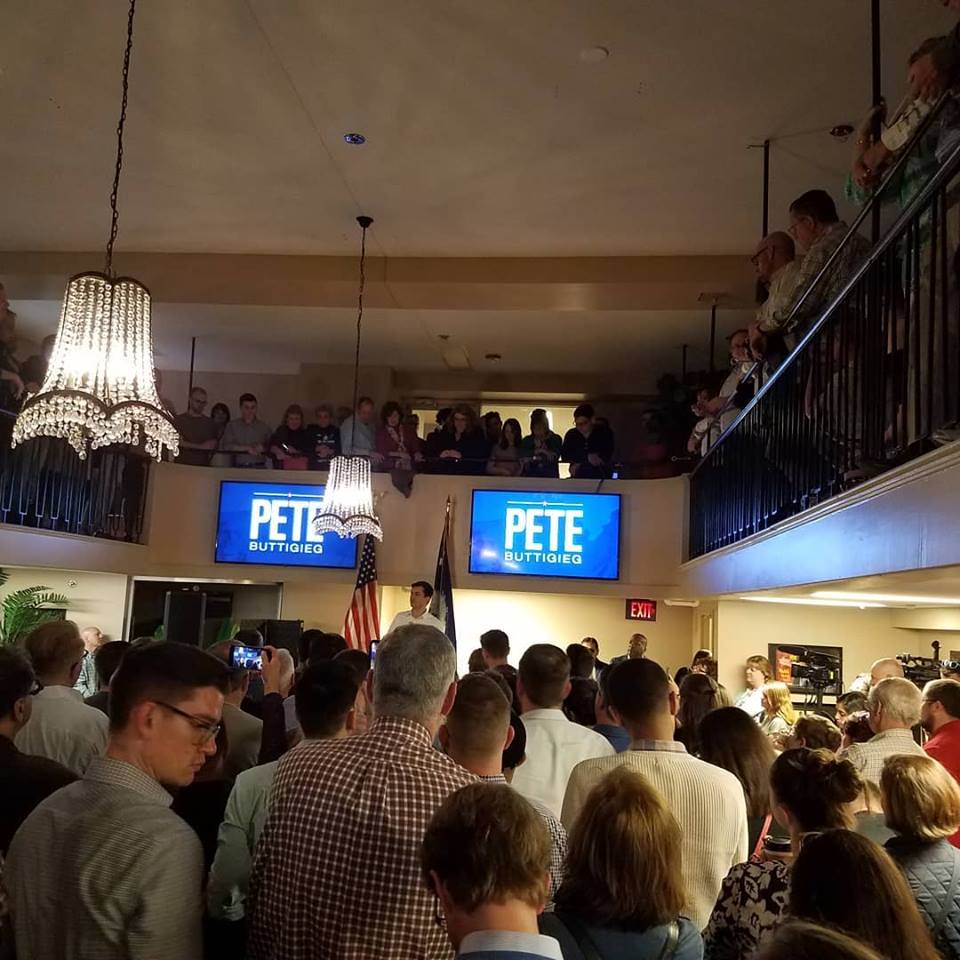
I’m currently on vacation in South Carolina, so when I saw that Democratic Presidential candidate Pete Buttigieg was doing a meet and greet in Columbia, I figured I would go.

If you’re unfamiliar with him (and judging by his early polling numbers, most people aren’t), he’s the 37-year-old mayor of South Bend, Indiana. He’s also the first major openly gay Presidential candidate. He’s a graduate of Harvard, a Rhodes scholar, and an Afghanistan war veteran. Oh, and his name is pronounced BOOT-uh-judge.

One of the first things he mentioned was the importance of Democrats competing in red states. He comes from Indiana, the home state of Mike Pence. The irony that Buttigieg comes from the state as a man who’s been long criticized for his views on LGBT rights is not lost on him. But Buttigieg remarked that Democrats in states dominated by conservatives still need to make their voices heard.

As quoted by Dan Merica of CNN, Buttigieg said today, “It’s time for a little more of a regional mix in the faces that our party puts forward in the highest level. We love our friends in the big cities, but it is time for us to confront the idea that any state or any county or any community has to be conservative just because it’s been voting Republican for the past few years. Where is it written that this has to be a Republican state? Where is it written that Indiana has to be a Republican state? So would it not make more sense for more people to come from red states from the Democratic party and change the way some people think about our part of the country?”

I noticed on twitter that it seemed this statement was a bit controversial among some. I think they’re interpreting it as Buttigieg saying the party needs to move in a more conservative direction. But I don’t think that’s what he was arguing. He was saying that it would help the party overall for some of the national voices in the party to come from conservative areas. And there’s precedent for that. Hell, from 1993 to 2001 we had a Democratic President (Arkansas) and Vice President (Tennessee) that both came from red states.

And the party can only benefit from increasing its strength in areas that might normally be more Republican. Democratic Senator Joe Manchin of West Virginia is often criticized for being too conservative. But Manchin is going to vote with the Democrats a hell of a lot more than a Republican in that seat would. If there’s a controversial piece of legislation up for consideration, I’d definitely rather have Manchin casting a 50/50 vote instead of a Republican that would vote against the Dems the vast majority of the time.

Look at the House. Democrats won a number of seats that were in areas normally occupied by Republicans. Conor Lamb won a special election in suburban Pittsburgh that had been Republican for a while. Orange County, CA saw a large number of traditionally red seats flip blue. And the representatives that won those seats are going to give a lot more votes for Democratic legislation than the Republicans that used to be there would. Are they going to be the most progressive? No. Will they occasionally vote against the Democrats? Probably. But it’s better to have them voting with you some of the time than a Republican that would vote with you none of the time.

Buttigieg’s point is well taken. If Democrats are going to win back the White House, it would be helpful to run a candidate that can have more widespread appeal.

My Tax Refund Went Down. That Doesn’t Mean My Taxes Went Up

So it’s tax season, and the full effects of the 2017 tax bill are starting to be felt for the first time. And for many people, they’re seeing smaller tax refunds. The IRS indicates that refunds are down by almost 9 percent on average.

This has led many people to say their taxes are going up. They say this is a big reason why the tax bill is bad. But this isn’t true. The bill is bad, but not for the reason people claim. I’ll get into that later.

The simple fact is that you need to look at your actual tax liability and its proportion of how much you made in 2018. For me, my tax refund is about $300 less than it was last year. But my tax liability actually went down. I ended up owing about a percent less in 2018 than I did in 2017, despite having relatively the same income.

The reason this has happened is because the bill changed up the amount in taxes that was withheld from peoples’ paychecks. So in effect, people were paying way more than they needed to from each paycheck, then getting a bunch of it back when it came time to get a refund. The new bill has tightened that up a bit, so that people aren’t paying as much on the front end as they are on the back end. I don’t know if I’d call this a positive or negative thing, but it is what it is.

It’s important to know what you’re criticizing though. I think the 2017 tax bill was bad for the country. More than 75% of the benefits of the corporate tax cuts go to wealthy shareholders.

It’s adding a huge amount to the deficit. $1.5 Trillion over the first 10 years in fact.

Deficits aren’t always bad, but the fact is that this deficit will be used as a reason to cut funding from programs for people that need it. The House GOP last year already proposed last year cutting Medicaid and Medicare to balance the budget.  So you have a plan that benefits the wealthy being used as a reason we need to cut money from poor people. Neat.

The tax bill was a giveaway to the wealthy. It’s bad for that reason. But diminishing refunds have nothing to do with why it’s bad.

10 Reasons Why Shutting the Government Down To Fund a Wall is Completely Asinine

We’re now on Day 32 of the government shutdown. About 800,000 federal workers remain without pay, and it appears there’s no end in sight. President Trump said he was “proud” to shut down the government in order to fund border security in the form of a wall.

Here are 10 reasons why that’s just asinine:

1. Illegal immigration is going down

The Pew Research Center estimates that the number of unauthorized immigrants in the country fell to its lowest level in 12 years in 2016. The number of undocumented immigrants has been steadily declining since it peaked in 2007. In short, President Trump is trying to fix something that is already doing a good job fixing itself.

2. Most undocumented immigrants didn’t cross over the border illegally anyway

For 7 years now, more undocumented immigrants have entered the country on a legal visa and overstayed it than ones who crossed over the border illegally. A wall wouldn’t do anything to stop those people.

3. Even if illegal border crossings were the main reason for illegal immigration, a wall wouldn’t be a good solution anyway

This just comes down to basic mechanics. It’s often dismissed as a cliche, but the kind of person who is willing to walk hundreds of miles through the desert isn’t going to be deterred by a wall. Saws exist. As do ladders. And the President’s recent claims of wanting to build steel slats wouldn’t strike much fear into anyone capable of either digging or cutting through said slats.

4. Undocumented immigrants provide positive economic benefits

They pay into Social Security benefits that they never cash out on, to the tune of $13 billion paid in and only $1 billion paid out in 2010.

That’s not to mention that when you consider the children of immigrants and the taxes they pay, immigrants end up as a net economic benefit to the U.S. A 2017 report from the National Academies of Sciences, Engineering, and Medicine said as much.

5. Mexico was supposed to pay for it anyway

It was one of the President’s signature campaign promises. “We’re gonna build a wall and Mexico’s gonna pay for it!”

Meanwhile people with a modicum of understanding of international diplomacy said, “Um, but how?”

The President gave multiple rambling explanations for how that was going to happen. First it was by taxing remittances by people in the U.S. to Mexico. Now, the President has switched his explanation for how they’ll pay. Now he says they’ll pay for it through savings the U.S. will incur through the new USMCA trade deal, which hasn’t even been approved by Congress yet. Needless to say, that’s not how any of this works.

But this all belies the point that if Mexico was paying for the wall, we wouldn’t need a Congressional appropriation for it.

6. A wall would cost way more than the $5 Billion the President is asking for

The amount of construction that a 1,000+ mile border wall would necessitate is hard to put into words. Just consider the fact that wherever you’re building a wall, you need to bring materials to do so. Some of these areas aren’t even directly accessible by roads. So in that case, you need to build a road to get there. Think about how long it takes to repair a mile of interstate highway, then extrapolate that to 1,000 miles in the desert.

Liberty Vittert at Fox News estimated it would cost more like $25 Billion.

So how long after this $5 Billion shutdown before the President is asking for more money because the wall isn’t even close to being finished?

7. The environmental cost and cost to personal property would be tremendous

In addition to the fact that a large part of the border is along the Rio Grande, so we’d just be putting a big barrier in the way of that, it would cause issues for endangered species. And it would be a massive construction project in an area that’s normally free of most human interaction.

On top of that, many people own the land near the border. Normally, you’d think small government conservatives would be against telling property owners that they’re just gonna take some of their land.

8. Shutdowns shouldn’t be used to settle policy differences

The political debate over the wall notwithstanding, the shutdown is having a real impact on peoples’ lives. Hundreds of thousands of people are about to go without a second paycheck in a row. National parks are being damaged because they’re left unstaffed. And this is all over something that is not germane to the people and things it’s impacting. A wall has nothing to do with the TSA.

9. Most people don’t want the wall anyway.

If the President were holding strong on something that had broad bipartisan support, that’d be one thing. But this is a controversial issue, and most people are not in favor of building a border wall.

Every House member whose district is actually on the border opposes building a border wall. And that includes 1 Republican.

10. Seriously, ladders

Just, ladders.


Bipartisanship Matters

Tonight I had the opportunity to see a discussion involving former U.S. Senator Jeff Flake. Flake, a Republican, is known best for making occasional critical comments of President Trump in his last 2 years in office. He decided not to run for reelection, and left office just a few weeks ago.

I think one of the things Flake illustrates is just how difficult it will be to achieve actual bipartisanship. I think bipartisanship is something that a lot of people claim to want, but they don’t actually want in truth. This has manifested itself perfectly in the trend of people trying to downplay the criticism that Flake has had of the President. They say, “Oh, well he just votes with the President anyway.” Yeah, no shit. He’s a Republican. If he started voting opposite the President all the time, he wouldn’t be a Republican anymore. Just because he believes (rightfully so) that President Trump is a man-child who’s lowering the level of discourse in this country to one level above Flavor of Love doesn’t change the fact that Jeff Flake is a conservative.

If you want to hand-wave away any sign of bipartisanship on Flake’s part as toothless, then I have to ask what are you hoping to accomplish? If Flake can’t criticize a member of his own party without being accused of not doing enough, then when are you ever going to be satisfied? There’s nothing in it for Flake if he decides that all criticism of Trump is gonna do is just going to piss off his base anyway, if the opposing party won’t even listen to what he has to say.

But why is bipartisanship in and of itself important? It’s because the alternative just leads to the kind of gridlock in Congress that has just increased over the last decade. If you view everybody on the opposite party of you as immoral, no matter what, then good luck trying to get 60 votes on anything in the Senate. And if you can’t get any bills passed, how do you plan to make any of the kind of changes that you’re hoping to make?

Try as they might, the Democrats are never going to occupy 100 seats in the U.S. Senate. The G.O.P. is here to stay. If you want President Trump impeached, as many people do, then you’re going to need at least 20 Republican Senators to vote to convict him. If you want them to do that, then it would help if you didn’t downplay any effort they might offer at bipartisanship. It’s like taking an olive branch and throwing it away because you wanted the whole olive tree.

Former Sen. Flake touched on something in his talk tonight that I think was especially prescient. He said that it’s difficult to have any sort of bipartisanship if a lawmaker is criticized if they even hint that they might be open to changing their mind. He specifically referenced that you’ll get criticized if you indicate that you might actually be willing to listen to the testimony at the hearing you’re about to go to.

This isn’t to try and portray Flake as some sort of hero. He’s not. The guy voted in a way that I disagree with on the majority of the votes he took while in office. But that’s going to be every member of the party I disagree with. If you hold everyone to a partisan purity test, good luck trying to get anything accomplished.